
Grayson County Court Records After Arrest
Court records after a jail arrest in Grayson County begin with the arrest-to-booking path, but they do not end there. A person may be booked into the Grayson County Jail on an arrest charge, warrant, capias, parole matter, or hold. After that first jail event, the case moves through magistration, bond review, prosecutor screening, and clerk filing. The Grayson County Criminal District Attorney's Office reviews criminal accusations and may accept, reject, amend, reduce, dismiss, or present charges for indictment.
The jail side and the court side answer different questions. A booking record can help confirm local custody, release status, or bond data. A court record shows whether a complaint, information, indictment, setting, plea, dismissal, deferred adjudication, conviction, acquittal, or final disposition exists. Current custody and booking details belong with Grayson County jail inmate records. Booking photos, when available or requested, belong with Grayson County jail mugshots.
Find Grayson County Court Records
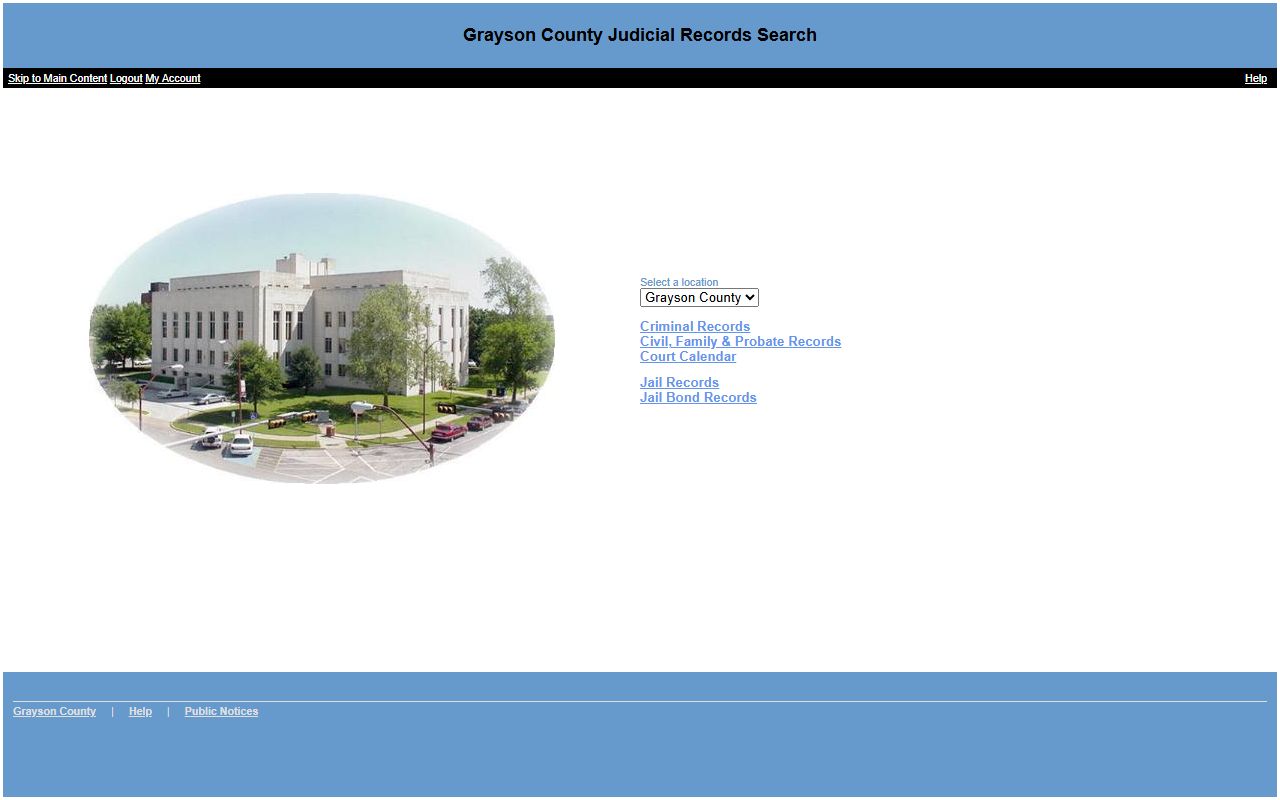
The confirmed local online route is the Grayson County Judicial Records Search. Its launch page offers Criminal Records, Court Calendar, Jail Records, and Jail Bond Records from the same entry point. For court records after a jail arrest, use Criminal Records for the formal case and Court Calendar for settings. Use Jail Records or Jail Bond Records only when the question is custody, jail events, bond, release, or holds.
| Field Label | Type | Required | Options / Format Notes |
|---|---|---|---|
| Select a location | Dropdown | Yes for court launch | Option shown: Grayson County. |
| Criminal Records | Link / button | No | Launches Search.aspx?ID=100 with the portal location post. |
| Court Calendar | Link / button | No | Launches Search.aspx?ID=900 for court date and setting review. |
| Jail Records | Link / button | No | Launches JailingSearch.aspx?ID=400 for jail-related records. |
| Jail Bond Records | Link / button | No | Launches JailingSearch.aspx?ID=500 for bond-related jail records. |
The captured image from the judicial-records launch page shows the entry points used for criminal case, jail, bond, and calendar research.
If a direct criminal, jail, or bond URL returns the launch page, return to the launch page and use the visible button so the portal can post Grayson County as the selected location.
Search Court Records After Jail Arrest
The best search order follows the case path. Start with the judicial portal for formal court records after a jail arrest, then compare jail and bond modules only when custody or release status is part of the question. If a case is too new, online records may lag behind magistration or prosecutor review.
- Open the Judicial Records Search launch page and select Grayson County if the dropdown is shown.
- Choose Criminal Records to look for the prosecutor-filed case by defendant name or case number when available.
- Open the case and read each charge, degree, court, setting, and disposition line instead of relying on the booking charge alone.
- Use Court Calendar when the question is a setting, appearance, or upcoming date.
- Use Jail Records or Jail Bond Records for custody events, bond type, bond amount, no-bond holds, or release conditions.
- Contact the District Clerk, County Clerk court offices, or Sheriff's Records Division if the case is older, sealed, juvenile, expunged, not online, or tied to a record that must be requested in writing.
Texas DPS Crime Records is a separate statewide channel for criminal-history and conviction search resources. It can help with broader Texas criminal-history questions, but it is not a substitute for the Grayson County court file or the official clerk record.
Grayson County Charging Documents
Formal court records after a jail arrest usually turn on the charging document. A jail record may show the arresting officer's charge or a warrant reason. The formal court case, however, depends on what is filed with the court or returned by a grand jury. In Grayson County, the Criminal District Attorney is the prosecutor's office named in the research for criminal charge review.
| Document | Who Uses It | What It Means | Common Context |
|---|---|---|---|
| Complaint | Officer, complainant, or prosecutor depending on context | A sworn allegation or early charging paper. | Often used early or in lower-level proceedings. |
| Information | Prosecutor | A prosecutor-filed charging instrument. | Common for misdemeanors and some waived-indictment contexts. |
| Indictment | Grand jury | A grand-jury charging instrument. | Generally used for felony matters. |
The charge shown in jail records can differ from the charge that appears in court. Prosecutors may reject a case, file a lesser offense, add counts, amend language, or present a felony to a grand jury. That is why court records after a jail arrest should be checked after the first booking screen.
Grayson County Charge Status
Charge status terms show where a case stands. They also help separate an accusation from an outcome. A pending charge is not a conviction. A dismissed charge may still appear in some public records until a court order, nondisclosure, or expunction process changes access. Always read the status next to each count, not just the lead offense name.
| Status | What It Means | Search Tip |
|---|---|---|
| Pending | The charge is active and unresolved. | Check future settings and bond conditions. |
| Filed | The prosecutor or clerk has opened the court case. | Compare the filed charge with the booking charge. |
| Indicted | A grand jury returned a felony charging instrument. | Look for new case numbers, settings, or amended counts. |
| Amended | Charge wording, count, degree, or allegation changed. | Read the latest docket entry, not only the first charge line. |
| Reduced | The charge level or offense was lowered. | Confirm whether the reduction was part of a plea, amendment, or dismissal. |
| Dismissed | The charge ended without conviction on that count. | Check whether other counts remain pending. |
| Deferred adjudication | A plea or probation outcome where adjudication is deferred subject to conditions. | Look for later adjudication, discharge, or nondisclosure issues. |
| Convicted | Guilt or adjudication was entered. | Review sentence, probation, jail credit, or prison-transfer entries. |
| Acquitted | A not-guilty finding was entered. | Check whether the record remains public or whether expunction may apply. |
Bond Records After Jail Arrest
Bond is the release framework, not the final case result. Texas Code of Criminal Procedure Chapter 17 is the core bail chapter. In Grayson County, the judicial portal includes a separate Jail Bond Records route, and the county also has a Bail Bond Board page for local bail-agent oversight context. Bond can be set or changed after magistration, indictment, new charges, warrant recalls, or court orders.
| Bond Type | How It Works | Grayson County Research Note |
|---|---|---|
| Cash bond | Money is posted directly as security for future court appearance. | Confirm accepted payment methods before arriving. |
| Surety bond | A licensed bail bond company posts the bond for a fee and conditions. | Grayson County has a local Bail Bond Board page. |
| PR bond | Release is based on a signed promise and conditions rather than full cash deposit. | Availability depends on court order and case facts. |
| No-bond hold | Release by bond is unavailable until a court or agency acts. | May involve warrant, parole, federal, ICE, or other agency holds. |
The official inmate communication page says the Grayson County Jail no longer accepts cash payments of any kind effective March 1, 2026. Since payment rules can affect bond and account funding, confirm current instructions with the jail or the relevant clerk before traveling.
Warrants and Court Arrest Records
No official Grayson County active warrant search page was located in the research. That is important. The jail roster or court portal may show a warrant-related arrest after booking, but neither should be described as a complete active-warrant list. Warrant data can sit with the sheriff, a court, a justice of the peace, a municipal court, another county, a parole authority, a federal agency, or immigration enforcement.
- Arrest warrant
- A judicial order to arrest a person on a criminal accusation.
- Bench warrant
- A judge-issued warrant, often for failure to appear or failure to follow a court order.
- Capias
- A writ or order directing custody after a court event, indictment, judgment, or noncompliance.
- Detainer
- A hold request from another agency that can delay release even when a bond amount appears.
A person arrested on a warrant may be booked into the Grayson County Jail, then appear in Jail Records, Jail Bond Records, Criminal Records, or a court calendar. The issuing court remains the key source for warrant status. Anyone who believes they have an active warrant should consider speaking with an attorney before appearing in person.
Charges vs Convictions
Court records after a jail arrest should be read with one basic rule in mind: a charge is an accusation, and a conviction is an outcome. The difference matters for employment, housing, licensing, custody status, and personal record review. It also matters because a jail booking can remain visible even when a case later ends in dismissal or acquittal.
| Point of Comparison | Charge | Conviction |
|---|---|---|
| Stage | Accusation after arrest, complaint, information, or indictment. | Final or adjudicated result after plea, trial, or court finding. |
| Proof level | Based on probable cause or charging decision. | Based on plea, verdict, adjudication, or legally sufficient proof. |
| Where found | Jail record, criminal case, indictment, or docket entry. | Disposition, judgment, sentence, probation, or conviction-history record. |
| May change | Can be amended, reduced, rejected, or dismissed. | Can be appealed, set aside in limited cases, or affected by later relief. |
Sealed and Expunged Records
Public access to court records after a jail arrest is not unlimited. Texas Government Code Chapter 552 sets the public-information framework, but other law can limit access. Texas Code of Criminal Procedure Chapter 55 covers expunction. Texas Family Code Chapter 58 addresses juvenile justice records. Texas DPS also publishes guidance on criminal-history data, expunction, juvenile records, nondisclosure, and correcting record errors.
| Point of Comparison | Sealed / Nondisclosed | Expunged |
|---|---|---|
| Public visibility | Hidden from many public searches, but not necessarily erased. | Removed or treated as no longer existing for most public purposes. |
| Agency access | Some criminal-justice or authorized entities may still have access. | Access is far more limited and depends on the expunction order. |
| Typical route | Court order under Texas nondisclosure rules when eligible. | Court order under Chapter 55 when the arrest or case qualifies. |
| Online effect | May remove public portal visibility while internal records remain. | May require agencies and publishers to respond to the order. |
Juvenile records, sealed records, expunged records, ongoing investigations, and some older files may not appear online. If the portal is blank, the next step is the correct clerk or agency, not a guess that no record exists.
Grayson County Court Contacts
The Justice Center cluster in Sherman makes Grayson County unusual for users because the jail, prosecutor, district clerk, county clerk court offices, and sheriff records functions are close together but still separate. Each office controls a different record set, so route the question to the right counter.
Criminal District Attorney
John Kermit Hill
200 S. Crockett, Suite 116A
Sherman, TX 75090
(903) 813-4361
Monday-Friday, 8:30 a.m.-5:00 p.m.
District Clerk
Kelly Ashmore
200 S. Crockett, Suite 120A
Sherman, TX 75090
(903) 813-4352
Monday-Friday, 8:00 a.m.-5:00 p.m.
County Clerk Court Offices
Deana Patterson
Justice Center, 2nd Floor
200 S. Crockett, Sherman, TX 75090
Monday, Tuesday, Thursday, Friday 8:00 a.m.-4:30 p.m.; Wednesday 8:30 a.m.-4:30 p.m.; closed 12:00-1:00 p.m.
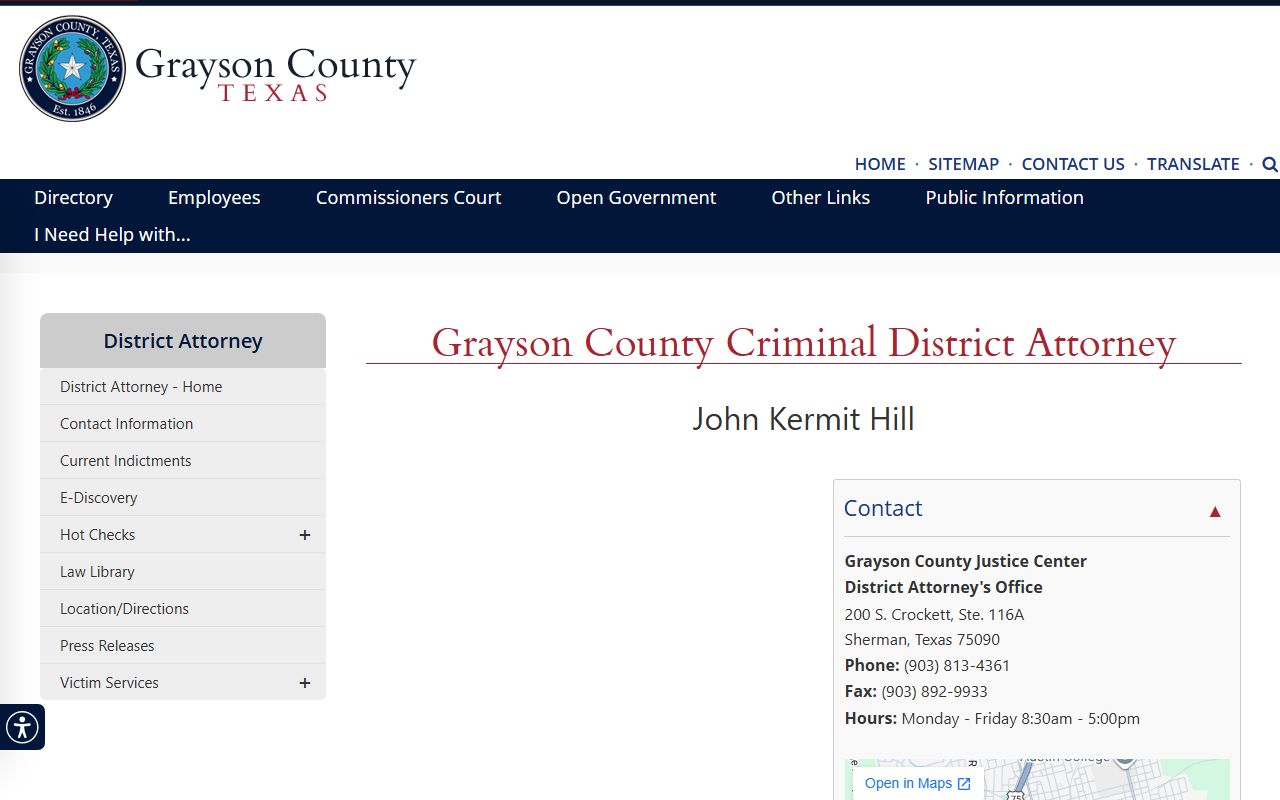
The official Criminal District Attorney page supplies the DA contact block used for prosecutor routing.
For booking records, incident reports, or jail records that are not court filings, use the Sheriff's Records Division and the written public-information request process instead of the prosecutor's office.
Access Limits After Arrest
Texas law supports access to many public records, but access can depend on the record type and case status. Texas Government Code Chapter 552 is the Texas Public Information Act. The sheriff's office says written TPIA requests must describe the specific records sought, and the agency has 10 business days to review and respond. It may charge for time and copying in voluminous requests after disclosing the cost.
For court records after a jail arrest, the better first source is the judicial search and the appropriate clerk. For sheriff records, use the public-information request. If a public body believes a record or part of a record is exempt, the research notes that it must seek a Texas Attorney General ruling and notify the requester. Attorney General review may take up to 90 days, with more time possible for large or complex requests.
Important: Online court and jail records are not consumer reports and should be verified with the official office before any serious use.